Thailand's AI opportunity is not cheaper talent. It is faster company-building.
Most people describe Thailand’s startup advantage with a cost-of-living spreadsheet.
That misses the important part.
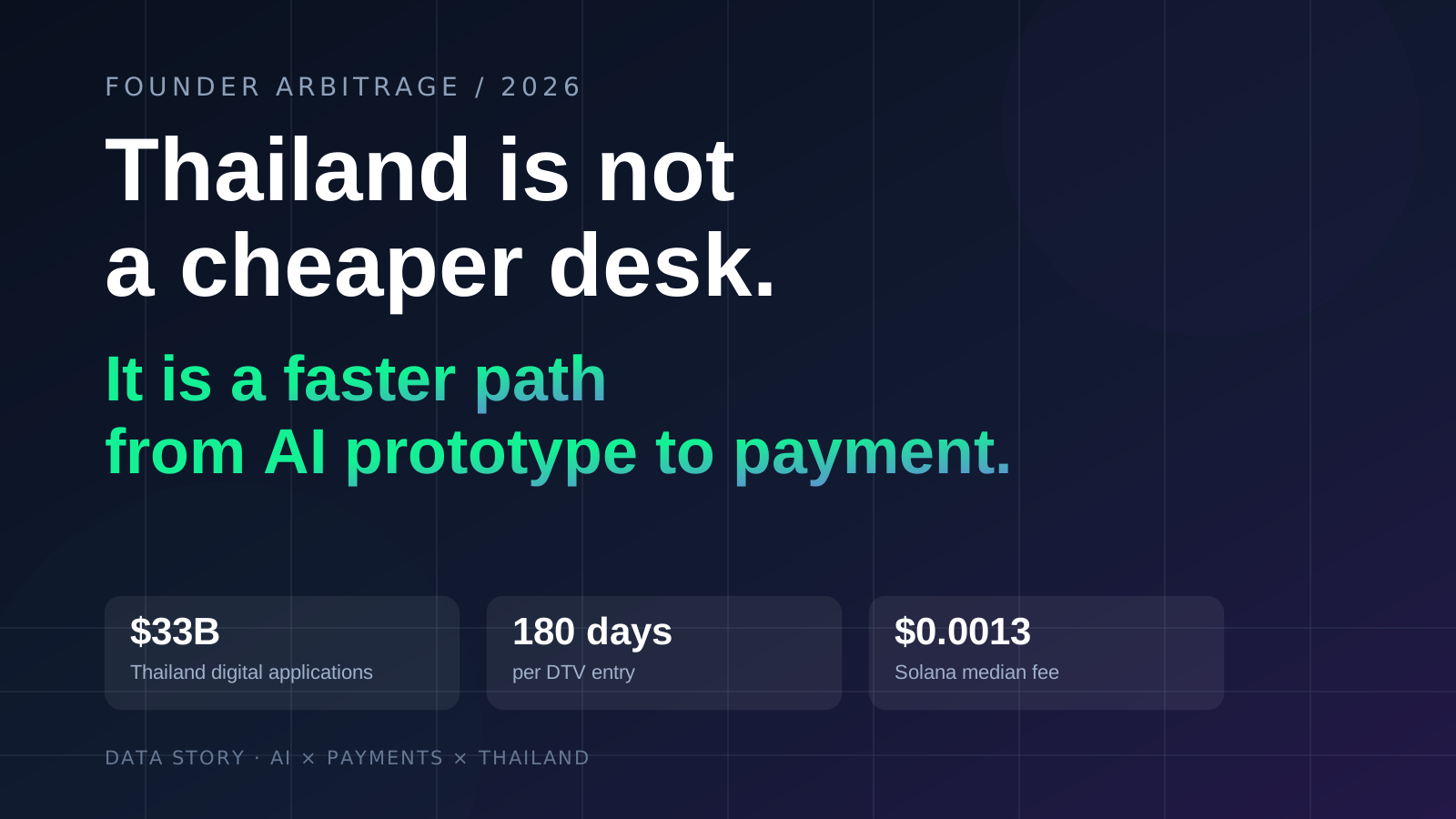
In the first half of 2026, investment applications in Thailand reached $43.6 billion. The digital sector alone accounted for $33 billion, led by data centers, cloud infrastructure, and AI capacity. This is not a story about finding a cheaper desk. It is a story about a country installing the physical layer for the next generation of software companies.
At the same time, Thailand’s five-year Destination Thailand Visa gives eligible remote workers, digital nomads, and freelancers stays of up to 180 days per entry. The practical effect is unusual: international builders can spend enough time in-market to discover a problem, meet users, ship a product, and iterate with the same community.
The missing layer is not more cloud compute. It is a better way for small, global software products to move value.
That is where Solana becomes relevant—even if the founder has never cared about crypto.
The useful mental model: Thailand is the lab; Solana is the transaction layer
An AI product can generate an answer in seconds. Turning that answer into a business is harder:
- How does an agent charge 3 cents for one verified action?
- How does a Thai creator sell globally without building country-by-country payment plumbing?
- How does a small team pay contributors across borders without waiting days for settlement?
- How does a merchant reconcile a programmable payment with an order automatically?
Solana’s payment stack is increasingly designed around those product questions. Its official payments data currently reports roughly $10 billion in stablecoin supply, $200 billion in monthly stablecoin transfers, and a $0.0013 median fee. Visa has already used Solana to move USDC between settlement partners. The developer tools now include payment links, checkout components, recurring transfers, and APIs for compliant financial products.
The pitch to a mainstream founder is not “put your company onchain.”
It is simpler:
Keep your product familiar. Use internet-native settlement only where it removes friction.
Three products worth building from Thailand now
1. AI agents that can charge for a completed action
The next useful agent will not just produce text. It will book, verify, compare, translate, reconcile, or deliver a result.
An agent serving tourism operators, exporters, creators, or regional e-commerce businesses could price a single action instead of forcing every customer into a monthly subscription. Solana’s low transaction cost and x402-style paid API flows make tiny, machine-triggered payments economically plausible.
Thailand matters because the test market is dense with exactly the messy, multilingual service workflows that agents can simplify—and with international customers who expose a product to global requirements from day one.
2. Stablecoin settlement hidden behind a normal checkout
Southeast Asian businesses do not need another speculative wallet. They need fewer failed cross-border payments, clearer reconciliation, and faster access to working capital.
A builder could create a conventional invoice, marketplace, or checkout experience while using stablecoins only in the settlement layer. The customer sees a familiar amount and receipt. The business gets a programmable payment reference, near-instant confirmation, and a global rail that operates continuously.
The strongest product will make the blockchain disappear.
3. Proof-of-work networks for creators and technical talent
Thailand already attracts developers, filmmakers, designers, operators, and independent founders. The opportunity is to connect visible work to visible payment: a small technical fix, a localized asset, a verified field report, or a reusable dataset.
Instead of a closed freelance marketplace, imagine a portable work graph where the deliverable, acceptance, and payment proof can travel with the contributor. Solana can handle the public verification and settlement; communities such as Superteam Thailand can provide the human network, local context, and distribution.
A 30-day founder experiment—not a relocation fantasy
The best way to test this thesis is not to move to Thailand and “network.” It is to arrive with one narrow customer problem.
Week 1 — Listen
Interview ten people in one workflow: boutique hotels, cross-border sellers, creator teams, event organizers, or software agencies. Find the handoff currently held together by spreadsheets, screenshots, chat messages, and bank transfers.
Week 2 — Build the smallest paid action
Do not build a platform. Build one result a customer can request, verify, and pay for. Keep wallets and chain terminology out of the user interface.
Week 3 — Run five real transactions
Measure completion time, payment failure, reconciliation effort, and support burden. A payment rail is only useful if the whole workflow becomes easier.
Week 4 — Publish the evidence
Share the workflow, what failed, what users paid for, and what you would change. Invite one Thai builder and one international founder to reproduce it.
That final step matters. Ecosystems grow when the next builder can see a credible path from idea to customer—not when they see another conference recap.
Why now
Thailand is making a serious infrastructure bet. The visa path gives global builders time to operate locally. Solana’s payment and agent tooling is moving closer to ordinary APIs and checkout components.
None of those facts guarantees a successful startup. Together, they create something more useful: a place where a small team can test a global product with local feedback, real transactions, and a much shorter learning loop.
Thailand’s overlooked advantage is not that building costs less.
It is that the distance between prototype, community, customer, and payment can become unusually short.
If you are building an AI, payments, consumer, gaming, or creator product, take one workflow you already understand and ask:
What would we build if a software agent could complete the work—and settle it globally—the moment the customer approved the result?
Then bring that question to Superteam Thailand and find the people already testing the answer.
Sources and methodology
- Thailand Board of Investment: first-half 2026 investment applications
- Thailand Ministry of Foreign Affairs: Destination Thailand Visa
- Solana: institutional payments data and case studies
- Solana developer documentation: accepting payments
- Solana products: agent, x402, payment, and platform tooling
Figures are the latest values published by the linked primary sources as checked on August 31, 2026. Investment applications represent proposed capital, not completed investment. Network statistics are dynamic and should be read as a current snapshot.